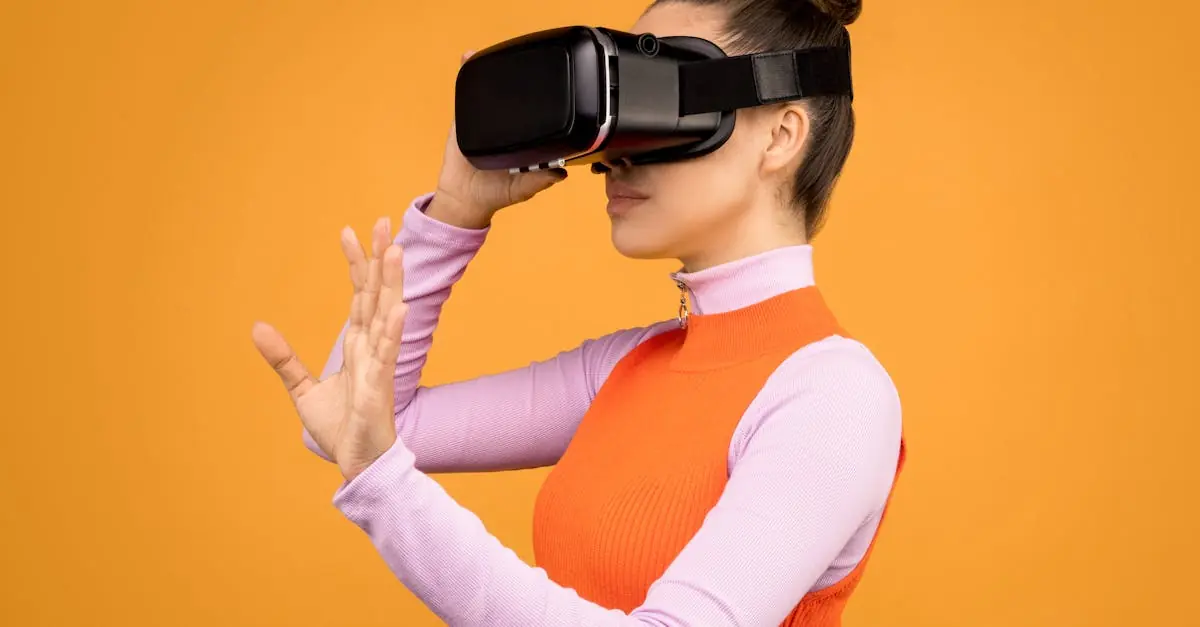
Imagine walking through a park and suddenly spotting a dragon lounging on a bench, sipping a latte. Sounds like a scene from a fantasy film, right? Welcome to the world of augmented reality (AR), where the extraordinary meets the everyday. This cutting-edge technology overlays digital information onto the real world, transforming how people interact with their surroundings.
In a nutshell, augmented reality blends the virtual and physical realms, making it possible to see things that aren’t really there—yet. From gaming to education and even retail, AR is revolutionizing experiences in ways that are both entertaining and practical. So buckle up as we dive into the captivating definition of augmented reality and explore how it’s reshaping our reality one pixel at a time.
Table of Contents
ToggleUnderstanding Augmented Reality
Augmented reality (AR) enhances the real-world environment by overlaying digital content. This innovative technology creates immersive experiences that blend virtual elements with physical spaces.
History of Augmented Reality
Early developments in AR trace back to the 1960s with Ivan Sutherland’s “Sword of Damocles,” the first head-mounted display. By the 1990s, researchers like Louis Rosenberg created Virtual Fixtures, an influential AR system. In 2000, ARToolKit brought AR to the public, allowing users to create their own augmented experiences. The smartphone revolution further accelerated AR’s growth, with apps like Pokémon GO launched in 2016, demonstrating its mass appeal. Today, industries widely adopt AR, pushing the boundaries of user interaction and engagement.
Key Components of Augmented Reality
Multiple key components drive AR technology. Hardware includes cameras and sensors, allowing devices to capture real-world data. Software processes this data, enabling the rendering of digital content. User interfaces, such as displays and haptic feedback systems, enhance interaction. Additionally, location tracking plays a critical role, as GPS and GPS-like technologies provide spatial awareness. Lastly, computer vision empowers the recognition of objects and surfaces, creating accurate overlays. Each component collaborates to deliver seamless AR experiences.
Applications of Augmented Reality
Augmented reality (AR) technology finds diverse applications across various industries. Its ability to blend digital elements with the real world creates innovative solutions and experiences.
Augmented Reality in Gaming
Gaming experiences transform through augmented reality. Players engage with virtual characters and settings that interact with their physical environment. For instance, Pokémon GO allows users to locate and capture digital Pokémon in their real-world surroundings. Such integration enhances immersion and fosters social interaction among players in shared spaces. Popular titles like Ingress further illustrate AR’s potential, encouraging exploration and collaboration within local communities.
Augmented Reality in Education
In education, augmented reality enriches learning experiences. Educators utilize AR tools to provide interactive lessons, making complex subjects tangible. For example, students can explore 3D models of historical artifacts or biological processes right in their classrooms. This hands-on approach enhances retention and understanding, leading to improved academic performance. Moreover, applications like Google Expeditions offer virtual field trips, expanding learning opportunities beyond traditional boundaries.
Augmented Reality in Retail
Retail sectors adopt augmented reality to enhance customer experiences. With AR, shoppers can visualize products in their homes before purchase, aiding decision-making. IKEA’s app allows users to see how furniture fits within their space, minimizing returns and increasing satisfaction. Furthermore, AR-driven promotions create engaging in-store experiences, attracting customers and boosting sales. Companies leverage this technology to stand out in a competitive market, integrating digital innovations with their physical offerings.
Challenges in Augmented Reality
Augmented reality (AR) faces several challenges that impact its development and user experience.
Technical Limitations
Technical limitations hinder AR’s potential. Hardware constraints, such as insufficient processing power in devices, affect graphical fidelity. Battery life remains a significant factor, as intensively running AR applications can drain resources quickly. Data latency can disrupt experiences, particularly in real-time applications. Device compatibility is also crucial; not all smartphones or tablets support advanced AR features. Users often encounter limitations based on their device capabilities.
User Acceptance
User acceptance poses another challenge. Some individuals express skepticism about AR’s practicality, viewing it as a novelty rather than a necessity. Concerns regarding privacy frequently arise when apps access personal data and surroundings. Usability remains vital; intuitive interfaces enhance user engagement. A lack of awareness about AR benefits can hinder adoption. Building trust and familiarity with the technology will encourage broader acceptance among potential users.
Future of Augmented Reality
The future of augmented reality (AR) promises significant advancements and transformative experiences. New trends continually shape how people engage with AR technologies.
Emerging Trends
Innovative hardware developments, such as lightweight smart glasses, enhance user experiences without compromising comfort. Increased integration of artificial intelligence boosts AR’s ability to process data in real time, creating more responsive environments. Furthermore, the rise of 5G networks allows for faster data transfer, reducing latency and improving overall performance. Companies are also investing heavily in software that tailors AR applications across industries, from entertainment to healthcare. These initiatives demonstrate a growing commitment to making AR more accessible and practical for everyday use.
Potential Impact on Society
Societal benefits of augmented reality extend to various sectors, including education, health, and commerce. In education, AR applications facilitate interactive learning experiences, making complex subjects more approachable. Healthcare specialists can utilize AR for surgeries, enabling precise navigation and enhanced patient outcomes. Retail benefits through personalized shopping experiences, as AR enables customers to visualize products in their environments before purchase. AR’s potential to enhance human connections and improve information accessibility heralds a transformative era in how society interacts with technology.
Augmented reality is not just a fleeting trend; it’s a powerful technology reshaping how people engage with their surroundings. By seamlessly blending digital content with the physical world, AR opens up a realm of possibilities across various sectors. As advancements in hardware and software continue to evolve, the potential for AR to enhance experiences in gaming, education, and retail becomes even more pronounced.
Despite the challenges it faces, such as technical limitations and user acceptance, the future of AR looks promising. With innovations like smart glasses and the rise of 5G, AR is set to become an integral part of daily life. As society embraces this transformative technology, the way individuals interact with information and each other will undoubtedly change for the better.