In a world where reality sometimes feels a bit too mundane, augmented reality solutions swoop in like a superhero, ready to spice things up. Imagine blending the digital and physical worlds seamlessly—it’s like adding a dash of hot sauce to your favorite dish. Suddenly, everything’s more exciting, engaging, and interactive.
From transforming how businesses showcase products to revolutionizing education with immersive learning experiences, augmented reality is not just a tech buzzword. It’s a game-changer. With its ability to captivate audiences and enhance user experiences, it’s no wonder companies are racing to adopt AR solutions. So, buckle up and get ready to explore the fascinating realm where reality meets imagination, and discover how AR can elevate everything from shopping to training.
Overview of Augmented Reality Solutions
Augmented reality solutions integrate digital enhancements into the physical environment, creating immersive experiences for users. Businesses in retail utilize AR to overlay product information and promotions, enhancing customer engagement during shopping. Educational institutions employ AR tools for interactive learning, allowing students to visualize complex concepts through 3D models.
Healthcare professionals leverage AR to display real-time information during surgeries, improving precision and outcomes. The construction industry benefits from AR by overlaying digital plans onto physical sites, aiding in project visualization and management.
Gaming companies focus on AR applications to immerse players in interactive worlds, bridging the gap between virtual experiences and reality. Training programs across various sectors implement AR simulations, enabling employees to practice skills in a controlled environment.
Many companies adopt AR solutions to gain a competitive edge, recognizing its potential to increase customer retention and satisfaction. The rise of AR is evident in the growth of applications available in app stores, with new innovations continually emerging. Organizations embracing AR technology prepare to remain relevant in a rapidly changing market landscape.
Key Technologies Behind Augmented Reality
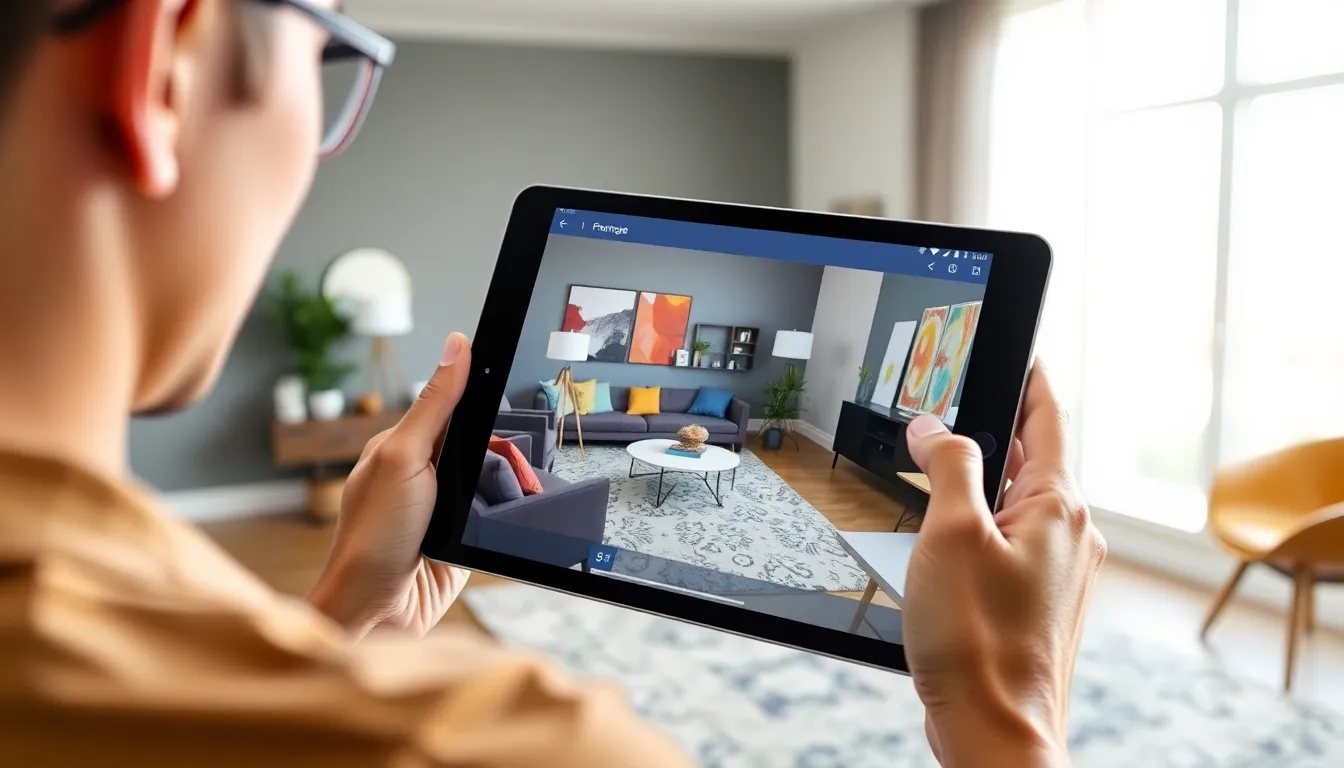
Augmented reality relies on several key technologies that make immersive experiences possible. These technologies include computer vision and depth tracking, among others.
Computer Vision
Computer vision plays a crucial role in AR by enabling devices to recognize and interpret visual data from the environment. Cameras capture images and analyze them in real time. Advanced algorithms process this data, identifying objects, surfaces, and spatial relationships. As a result, AR systems can overlay digital content onto physical environments accurately. Examples include facial recognition features in AR social media filters and object recognition in retail apps. Accurate identification enhances user experiences, creating a seamless blend of digital and physical worlds.
Depth Tracking
Depth tracking enhances AR by allowing applications to perceive distances and shapes within the physical environment. This technology utilizes sensors and cameras to determine the spatial location of objects. Structured light and time-of-flight methods are popular techniques employed in depth tracking. When implemented effectively, depth tracking enables AR systems to create more realistic interactions by adjusting digital content to suit the environment’s contours. Examples include virtual furniture placement in interior design apps and interactive gaming experiences that adapt to real-world obstacles. This capability significantly improves AR’s functionality and user immersion.
Applications of Augmented Reality Solutions
Augmented reality (AR) solutions find diverse applications across various fields, transforming how users engage with content and environments.
Education and Training
In education, AR enhances learning by providing interactive experiences. Students visualize complex subjects through 3D models, grasping concepts in ways traditional methods can’t achieve. Educators often use AR for virtual field trips, making distant historical sites accessible. Training programs also benefit, as AR simulations allow for hands-on practice in safe environments. Professionals refine skills through realistic scenarios, improving confidence and competence.
Healthcare Innovations
Healthcare sees significant advancements thanks to AR technology. Surgeons utilize AR to overlay critical information on patients during procedures, boosting accuracy and safety. Medical students benefit from AR anatomy lessons, allowing them to explore human anatomy in detail. Additionally, AR aids patient education by illustrating treatment plans and procedures, leading to informed decisions. These innovations contribute to better outcomes and enhanced patient experiences.
Retail and E-Commerce
In retail, AR transforms shopping experiences, providing customers with immersive interactions. Virtual try-ons allow shoppers to visualize clothing or accessories without physical trials. Brands often leverage AR to display product information, enhancing engagement with promotional content. Augmented reality apps help consumers make informed purchasing decisions by integrating reviews and comparisons. This interactive approach fosters brand loyalty and satisfaction, driving increased sales for businesses.
Benefits of Augmented Reality Solutions
Augmented reality solutions deliver significant advantages across various sectors. They enhance user interactions and promote deeper connections between digital content and the physical environment.
Enhanced User Experience
Enhanced user experience stands out as a primary benefit of augmented reality solutions. Users find interactions more immersive and engaging due to real-time overlays that add layers of information. Education, for instance, employs AR to allow students to visualize difficult concepts in 3D. Retail environments benefit similarly when customers can explore virtual try-ons, allowing for informed purchasing decisions. Integration of AR creates a seamless connection between physical and digital elements, enriching the overall user experience while making tasks easier and more enjoyable.
Increased Engagement
Increased engagement arises as another key advantage of augmented reality solutions. Users often interact longer with AR-enhanced content compared to traditional methods, fostering a sense of curiosity. The adoption of AR in gaming makes gameplay more captivating, as players immerse themselves in interactive worlds. Retailers witness improved brand loyalty when customers engage with AR advertisements and promotions. Educational institutions gain attention through interactive lessons that keep students intrigued. AR creates compelling experiences that not only capture attention but also maintain it, revolutionizing how individuals connect with content.
Challenges in Implementing Augmented Reality Solutions
Implementing augmented reality solutions poses several challenges that organizations must navigate. Initial costs for the technology can be significant, impacting budget allocations for many companies. Training staff to effectively use and maintain AR systems also requires time and resources that some organizations may not readily have.
Integration with existing systems often presents hurdles. Legacy software and hardware may not support new AR technologies, complicating deployments. User experience can suffer if AR applications are not designed with intuitive interfaces, leading to confusion or frustration among users.
Data privacy concerns emerge as AR systems often require access to sensitive information. Companies must prioritize security measures to protect user data, balancing innovation with compliance regulations. Moreover, varying hardware capabilities across devices can create inconsistency in user experiences, impacting overall effectiveness.
Scalability issues arise when solutions must be adapted or expanded. As demand increases, maintaining performance across multiple platforms can become complex. Furthermore, ensuring seamless connections between digital and physical environments is crucial yet often challenging.
Lastly, staying updated with rapid technological changes in the AR landscape presents another obstacle. Organizations may struggle to keep pace with evolving tools and best practices, risking obsolescence. Addressing these challenges requires strategic planning, a commitment to continuous learning, and a focus on user-centered design.
Augmented reality solutions are reshaping how businesses and individuals interact with the world. As technology continues to evolve AR’s applications will only expand further enhancing user experiences across various sectors. Companies that adopt AR can expect to see increased engagement and improved outcomes which are crucial in today’s competitive landscape.
While challenges exist in implementation organizations that prioritize strategic planning and user-centered design can overcome these obstacles. The future of AR is bright and its potential to transform industries is undeniable. Embracing this technology will not only keep businesses relevant but also create captivating experiences for users.