Augmented reality isn’t just a fancy buzzword anymore; it’s transforming how people interact with the world. Imagine walking down the street and spotting a virtual dinosaur lurking behind a tree or trying on a pair of shoes without ever leaving your couch. Sounds like sci-fi? Welcome to the future, where AR takes center stage and turns everyday experiences into something extraordinary.
Overview of Augmented Reality Trends
Augmented reality (AR) continues to evolve, reshaping various industries by blending digital information with the physical world. Growth in mobile AR applications stands out, with increasing integration in shopping environments. Retailers offer virtual try-on capabilities, allowing customers to see how products fit before making a purchase.
In gaming, AR technology enhances user experiences, drawing players into immersive virtual landscapes. Popular games using AR, such as Pokémon GO, exemplify this trend by encouraging outdoor exploration while interacting with digital creatures.
Education benefits from AR’s ability to provide interactive learning experiences. Educational institutions utilize AR to create engaging lessons and simulations, making complex subjects accessible. Students visualize concepts, enhancing understanding through practical applications.
Healthcare also sees significant advancements due to AR trends. Surgeons employ AR tools during operations for improved precision, overlaying critical information onto their field of vision. This technology aids in training medical professionals, creating realistic scenarios without risks to patients.
Advertising increasingly leverages AR to craft engaging campaigns. Brands create interactive ads, allowing consumers to interact with virtual products using a smartphone or tablet. This approach results in heightened customer engagement and brand loyalty.
Finally, the rise of AR glasses marks a pivotal trend. Companies develop wearable devices, offering hands-free access to information while allowing seamless interaction with the environment. As technology advances, AR glasses are anticipated to become more accessible and widely adopted.
These trends in augmented reality reflect its potential to revolutionize interactions across sectors, providing enhanced experiences that bridge the gap between the digital and physical worlds.
Emerging Technologies in Augmented Reality
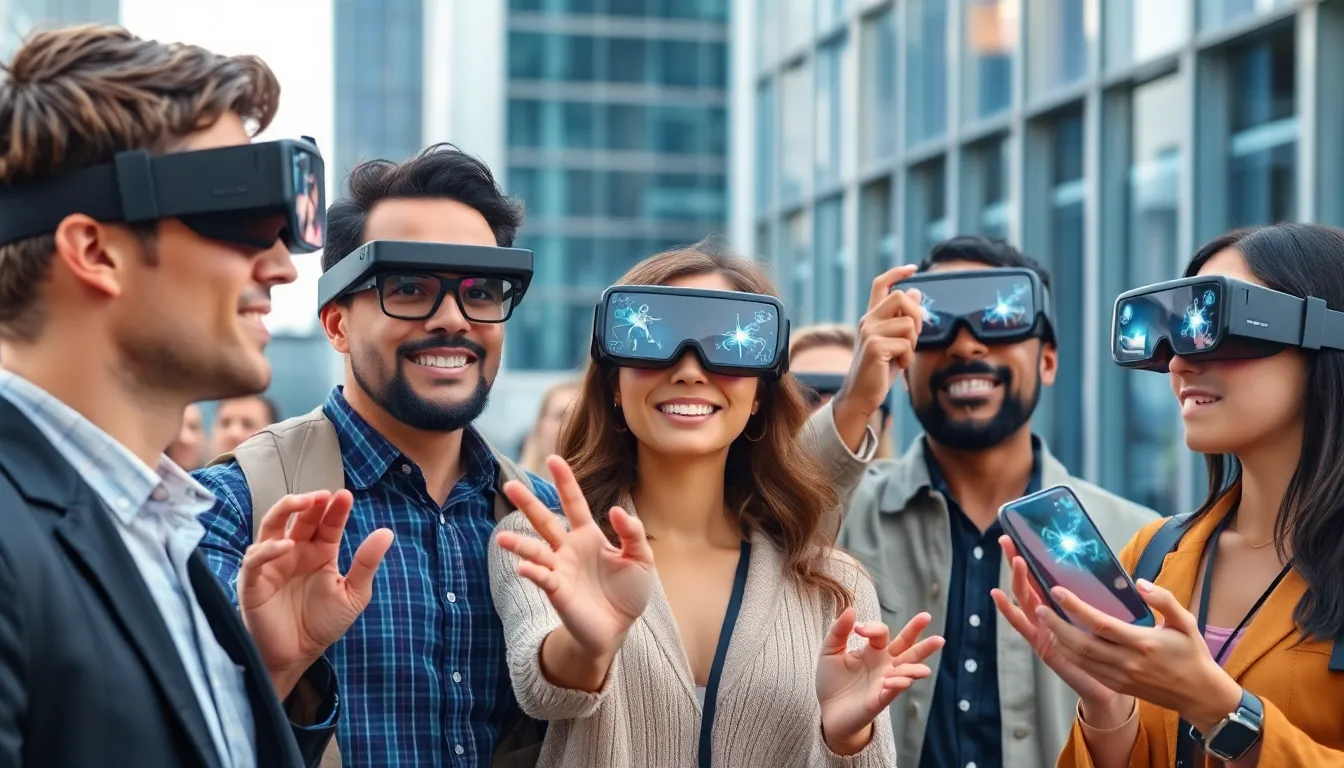
Emerging technologies continue to shape augmented reality, enhancing its capabilities and applications across various sectors.
Artificial Intelligence Integration
Artificial intelligence integration enhances augmented reality experiences by improving personalization and interactivity. AR applications now utilize AI algorithms to analyze user behavior and preferences. With this technology, virtual elements become more relevant and engaging. For instance, AI enables real-time object recognition, allowing users to interact with their environments effectively. Personalized recommendations further streamline user experiences in retail and gaming. As AI and AR converge, their combined potential can revolutionize how individuals interact with virtual content.
Improved Hardware Capabilities
Improved hardware capabilities significantly boost the performance of augmented reality applications. Devices equipped with advanced processors, high-resolution displays, and better sensors create seamless AR experiences. As a result, users enjoy enhanced performance without latency or lag. Innovations in technologies like LiDAR improve spatial mapping, enabling more precise placement of virtual objects in real-world contexts. Additionally, lightweight AR glasses offer mobility without sacrificing functionality. Such advancements in hardware pave the way for continued growth in AR applications across industries.
Industry Applications of Augmented Reality
Augmented reality (AR) significantly impacts various industries, enhancing both functionality and user experiences.
Healthcare Innovations
Healthcare leverages AR for training and surgical procedures, improving precision in complex operations. Surgeons utilize AR overlays to visualize anatomy, enhancing their real-time decision-making. Medical professionals engage with interactive 3D models that allow for better understanding of patient conditions. For instance, AR applications simulate patient anatomy, providing detailed insights during pre-surgical planning. This technology bridges the gap between theoretical knowledge and practical skills. Additionally, AR can assist in patient education by visualizing treatment plans, ensuring better understanding and adherence. These innovations improve outcomes and revolutionize how healthcare professionals approach their work.
Retail and E-Commerce Enhancements
Retailers use AR to transform shopping experiences, making them more engaging and interactive. Virtual fitting rooms allow customers to try on clothes without leaving home, boosting buyer confidence. Retail apps enhance product visualization, enabling customers to see how items fit into their environments before buying. For example, furniture retailers offer AR features that visualize how a couch looks in a living room setting. These enhancements not only increase conversion rates but also reduce return rates, benefiting retailers. Interactive advertising campaigns through AR capture attention and create memorable interactions, driving brand loyalty. Retail and e-commerce industries maximize AR’s potential, reshaping consumer behavior and expectations.
Social Impact of Augmented Reality Trends
Augmented reality (AR) significantly influences social interactions and engagement across various sectors. Its role in education and social media integration showcases its transformative capabilities.
Education and Training Benefits
AR enhances education with interactive lessons and immersive experiences. Students engage with content through 3D visualizations, aiding comprehension of complex topics. Teachers leverage AR to create participatory environments that increase student motivation. Training programs also benefit, allowing professionals to practice skills in simulated settings. For example, medical trainees utilize AR to visualize anatomy and hone surgical techniques. Statistics show AR improves retention rates by up to 75%, making learning more effective and enjoyable.
Social Media Integration
Social media platforms increasingly incorporate AR, elevating user engagement. Users can apply AR filters and effects to create unique content, enhancing their online presence. Brands utilize AR for interactive marketing campaigns, encouraging sharing among users. Data indicates that AR-driven campaigns boost user interaction by 30%, fostering deeper connections with audiences. Platforms like Instagram and Snapchat leverage AR tools to keep users entertained and invested in their content, shaping the social media landscape.
Future Predictions for Augmented Reality
Augmented reality is set to redefine interactions across numerous sectors. Forecasts suggest a market value of approximately $198 billion by 2025, driven by growing consumer demand. Increased investments from major tech firms highlight AR’s potential for widespread adoption.
In retail, AR applications are expected to expand, improving online shopping experiences. Virtual fitting rooms might become standard, allowing consumers to visualize products on themselves before purchasing. Enhanced product visualization can lead to increased buyer confidence and lower return rates.
Education stands to benefit significantly from AR advancements. Engaging, interactive lessons may see adoption in classrooms, with immersive experiences enhancing student retention rates. Predictions indicate that AR could increase learning retention by as much as 75%, making complex subjects easier to grasp.
Healthcare will likely see further integration of AR tools, aiding in surgical procedures and medical training. Simulated training environments might enhance decision-making and precision, positively impacting patient outcomes. Surgeons could rely on AR for real-time data visualizations during operations.
Social media platforms may increasingly utilize AR features to boost user engagement. With the introduction of interactive filters and effects, brands could strengthen connections with audiences, improving interaction metrics by 30%. This shift may redefine content creation, making it more participatory.
AR glasses are anticipated to gain traction, offering hands-free data access. Lightweight devices with advanced displays might enable seamless interaction with both digital and physical environments. Enhanced functionalities could transition AR from novelty to necessity in daily life.
Overall, these predictions indicate that AR will transform various sectors, enriching user experiences. Continued technological advancements will shape the landscape, leading to innovative applications and functionalities. Collaboration between industries will fuel this evolution, creating opportunities yet to be envisioned.
The future of augmented reality is bright and full of potential. As it continues to evolve across various industries the impact on everyday experiences will be profound. From enhancing retail shopping to transforming educational methods AR is set to redefine how people interact with the world around them.
With advancements in technology such as AI and improved hardware the possibilities for AR applications are limitless. As businesses and consumers embrace these innovations the integration of AR into daily life will become increasingly seamless.
This trend not only promises to enhance user engagement but also to foster deeper connections between digital and physical realms. As AR technology matures it will undoubtedly open new avenues for creativity and functionality across all sectors.